
Calling In: Navigating Challenging Conversations with Dr. Loretta J. Ross
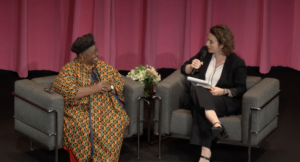
Dr. Loretta J. Ross in conversation with Maia Ferdman of the UCLA Bedari Kindness Institute, discusses her latest book, Calling In: How to Start Making Change with Those You’d Rather Cancel.
By Cylin Wang
On Tuesday, February 10, members of the public gathered at the Hammer Museum for a forum featuring Prof. Loretta Ross in conversation with Maia Ferdman, deputy director of the UCLA Bedari Kindness Institute. As part of the Hammer Forum’s series of public discussions, the conversation highlighted the relational and conversational method of calling in – an approach developed by Ross through five decades of transformative human rights activism. According to Ross, calling in creates change, accountability, and constructive conversation with “those you’d rather cancel.”
Prof. Ross described her varied experiences “calling in” the most unlikely people – those typically considered her “enemies,” including convicted rapists or ex-KKK members. She used these experiences to illustrate the power of calling in not just to transform others, but to transform herself from a place of outrage to a more sustainable place of healing and change-making. Through years of practice, Ross put faith in calling in as a philosophical and tactical choice to “build bridges instead of burning them down, so that we might walk together along the path toward collective liberation.”
According to Ross, the instinct to call in is inherently human. When natural disasters strike, people usually react by asking “Can I help?” The same impulse, she argues, should apply to man-made disasters like poverty and racism. Ross emphasized that these natural tendencies can be nurtured and regenerated and described compassion to be the “best antidote for the toxicity of our times.”
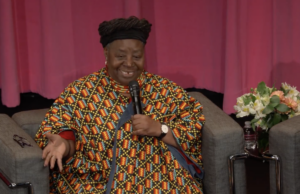
In an uplifting call toward “compassion justice,” Ross emphasized that passion without compassion can lead to brutalization and silencing of one another. To practice calling in, Ross empathized “you can always say what you mean and mean what you say, but you don’t have to say it mean. [The key is] calling attention to the harm without intending to wound or humiliate.” When Ferdman brought up an example from Ross’s book of a university professor reading a poem containing the N-word and getting reassigned due to student objections, Ross reflected that instead of jumping to cancel the professor, calling in would have involved asking the professor why he would act in such a way that risks hurting others.
Ross shared a range of perspectives and strategies to help audience members who may find the work of calling in difficult. For instance, to maintain joy, empathy, and kindness, Ross grounds herself in knowing her actions of calling in are “not what you do for other people; it’s what you do for yourself because that’s who you are.” She also said one must practice self-forgiveness—to be kind to oneself first—to practice lasting kindness for others. Ross also shared how she sees herself as a descendent of people who fought and died for the freedoms she now enjoys. “We get to say things to white people now that would have gotten our grandparents lynched,” she said. Ross urged the audience to maximize their privilege and offered the analogy of the “chain of freedom”: a historical tether that stretches back to your ancestors and forward to your descendants. Right now, “your only role and responsibility…is to protect the link that you are in that chain. And don’t weaken that link through hopelessness, despair, apathy, or being too tired to know you are that link … I’m tired all the damn time. I’m scared all the time, too. But I ain’t gonna ever break that link. Ever.”
About Calling In: How to Start Making Change with Those You’d Rather Cancel
“At once a handbook, a manifesto, and a memoir. With stories from five remarkable decades in activism, Loretta vividly illustrates why calling people in—inviting them into conversation instead of conflict by focusing on your shared values over a desire for punishment—is the more strategic choice if you want to make real change. And she shows you how to do so, whether in the workplace, on a college campus, or in your living room.” —Loretta J. Ross official website.
About Dr. Loretta J. Ross
Beginning her career in 1979 with the DC Rape Crisis Center, the first of its kind in the U.S., Dr. Loretta Ross is an activist, public intellectual, professor and author who has been advancing human rights for the past five decades. She co-founded the SisterSong Women of Color Reproductive Justice Collective and the Center for Human Rights Education. Ross was inducted into the National Women’s Hall of Fame in 2023 and MacArthur Genius Fellow in 2022. She currently holds an associate professor position at Smith to teach about call-out culture and white supremacy. Ross spreads her ideas on media channels such as TED, CNN, National Geographic Channel, Time Magazine, the New York Times, various podcasts and many more. Her work continues to define and shape how we think about reproductive justice, human rights and social change.
About Maia Ferdman
Maia Ferdman is the Staff Director of the UCLA’s Dialogue Across Difference Initiative, the Deputy Director of the Bedari Kindness Institute, and the founder of Bridges Intergroup Relations Consulting. She is a designated bridge-builder and educator to spread methods to facilitate difficult dialogues on political topics such as policing, homelessness, racial equity and more. She has developed various programs and trained government and nonprofit groups to advance cultural competence and help grow spaces of belonging.
