
Compassionate Conversation: Fr. Greg Boyle, Valarie Kaur, Rabbi Sharon Brous, and Imam Dr. Jihad Turk share multifaith views on justice, forgiveness, and compassion
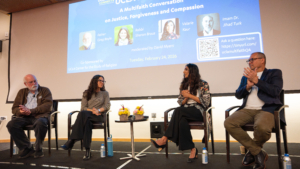
The multifaith panel (L-R): Father Greg Boyle, Rabbi Sharon Brous, Valarie Kaur and Imam Dr. Jihad Turk. Photo by Naheed Choudhry.
By Hannah Park
On Tuesday, Feb. 24, the UCLA Bedari Kindness Institute (BKI) welcomed distinguished religious leaders Father Greg Boyle, Rabbi Sharon Brous, Valarie Kaur and Imam Dr. Jihad Turk to a multifaith panel as part of BKI’s “Compassionate Conversations” speaker series. After participating in an intimate small-group dialogue with UCLA students, the panelists shared their views on justice, forgiveness, compassion and other uplifting themes to a large audience. The event was followed by a reception and a book signing by the panelists.
By sharing resonant anecdotes and personal mantras, and championing hope and cooperation, the four panelists made a powerful case that multifaith dialogue in the twenty-first century is not just possible, but essential.
Part 1: Small-Group Dialogue with UCLA Students
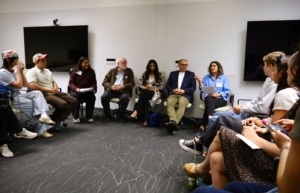
Felicia Graham, a Dialogue Across Difference graduate fellow, introduces the panelists and lays the framework for the small-group discussion. Photo by Hannah Park.
During the first small group dialogue, the panelists conversed with around twenty students from a variety of religious backgrounds. The participants asked thought-provoking and often personal questions reflecting their diverse perspectives. They included UCLA students from all backgrounds including a future volunteer at Fr. Boyle’s Homeboy Industries, students passionate about mental health, advocates for queer youth, and Dialogue across Difference student interns.
As the panelists digested the students’ questions, it was clear that all four leaders were uninterested in “winning arguments.” Instead of engaging in intellectual or theological debate, they emphasized love in action—Fr. Boyle’s 42 years of walking alongside and rehabilitating gang members served as a powerful example. Moreover, Imam Dr. Turk suggested a healthy order for connecting with others: “Hands, heart, head.” One should serve others—such as when Imam Turk opened an interfaith food pantry—and form deep relationships in order to share the beauty of one’s faith, rather than jumping straight into heated debate.
As Rabbi Brous described, religious “particularism” and “universalism” are not mutually exclusive. All four religious leaders expressed deep love for their faith traditions and also searched for resonant echoes across their beliefs. Ultimately, one should reach the same conclusion: to love humanity as a whole, and to extend one’s circle of care to all.
“To be religious in the 21st century is to be interreligious.”
– Imam Dr. Jihad Turk
Valerie Kaur shared a beautiful lens to foster interfaith appreciation: she invited her listeners to see religious histories, stories, prayers and scriptures as jewels in a treasure chest. Some are jagged, having the ability to be weaponized and “destroy the world,” while others are lovely diamonds that can “birth the world we want.” She referred to Noah’s ark, a tale familiar to Abrahamic religions: just as Noah chose pairs of animals to bring to the new world, we may also choose spiritual or religious values to live by.
Some other important topics of discussion included: reading controversial and often mis-represented passages of scripture in context (Imam Turk shared a re-interpretation of a difficult quote from the Qur’an); the wisdom that can arise from novel spiritual experience (Rabbi Brous shared an anecdote about herself and her fellow panelists attending Christmas Mass together); and navigating grief (Fr. Boyle emphasized communicating love rather than certainty).
Before transitioning to the large-group panel, I had the opportunity to ask panelists whether they had a favorite mantra to ground them and remind them to live with passion and presence.
The panelists shared their favorite mantras:
Valarie Kaur
“I get to be alive. I get to be alive today. I get to be alive today, with you.” Kaur says this with her children each morning.
“I see no enemy, see no stranger. There is no evil in the world, and no monsters. Just wounded people. You are a part of me that I do not yet know.”
Imam Dr. Jihad Turk
“God made us diverse for a reason: he could have just made us all the same. Just pursue the common good. God will settle our differences after [this life].”
Fr. Greg Boyle
“See Jesus standing in a lowly place. Why is he standing there?” (attributed to St. Ignatius)
Rabbi Sharon Brous
“Out of a narrow place I cried out to you; you responded with expansive possibilities.” (attributed to Victor Frankl)
“Breathe in God’s light, breathe out your light.”
Part 2: Compassionate Conversation
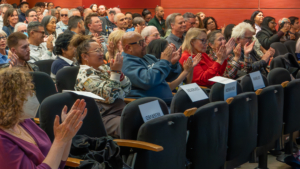
The audience welcomes panelists with applause at the beginning of the conversation. Photo by Naheed Choudhry.
Following the session with students the panelists then took the stage of the California NanoSystems Institute for the public program.
Prof. David Myers, BKI Director and panel moderator, opened with a quote from George Saunders that left many audience members nodding in agreement: “Kindness is the only non-delusional response.” He invited audience members to consider the place of religion in society at large: as both an incubator of beautiful values but also the source of bellicose division.
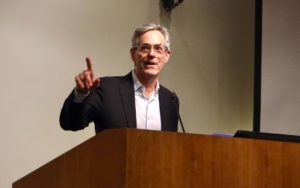
Professor David Myers shares a quote from George Saunders. Photo by Hannah Park.
All four panelists were invited to share details about their personal background. Fr. Boyle described his Catholic upbringing and his eventual transcendence beyond rules and single-minded evangelism: he expanded his circle of compassion in tandem with his image of a “spacious God.” Rabbi Brous shared that she grew up in New Jersey, but did not consider herself religious until the age of 19—when she realized that every human person was made in God’s image, with a “spark of the divine.” Kaur described the racist taunts she endured as a child and her grandfather’s encouragement to be a sant sipahi: a sage warrior with eyes of love and a fearless spirit of action. Imam Turk shared his familial religious background—his mother a Methodist Christian from Oklahoma, and his father a Palestinian Muslim. He shared an anecdote from the Quran about a man who believed he was guaranteed salvation as he ridded himself of all animosity toward any other person each night before he slept.
“The world wants to make you feel naïve for loving, but love is the only thing that can carry us through.” – Valerie Kaur
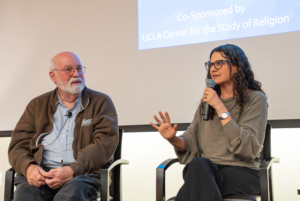
Rabbi Brous shares a myriad of lessons, parables and stories. Photo by Naheed Choudhry.
The panelists then tackled a set of challenging questions. When confronting the role of religion as a source of division, Imam Turk pointed out that over the course of his Islamic studies doctorate at UCLA, he realized that many violence-laden events and conflicts (such as 9/11 and the Troubles in Ireland) were more associated with nationalism or ultranationalism rather than motivated by religious values. Rabbi Brous mulled over the over-institutionalization of religion (i.e. obsessive focus on rules, laws, and rituals), and used the Benedictine analogy of a volcano. When a mystical tradition arises, it is a vibrant, radiant and powerful eruption. However, hundreds of years later, religious fervor often cools into an unrecognizable, lukewarm set of traditions.
“We try to build containers to contain an experience, but containers are not the experience,” Rabbi Brous said. “All traditions can, and have been, sources of harm.”
That said, religion can also be a source of inspiration, especially when fostering empathy and dedicating one’s life to serving others. Fr. Boyle and Kaur talked about the compassion they extended to all—even the most difficult individuals. Fr. Boyle referred back to Myers’ quote from George Saunders: he asked the audience to consider this question: who gives assent to the sentence that “kindness is the only non-delusional response”?
Fr. Boyle went on to answer his own question. He urged the audience to see the marginalized and other suffering individuals not through the lens of sin and evil, but rather in terms of health. “Healthy people are kind,” Fr. Boyle said. “Gang violence is not hate. [It’s the] lethal absence of hope…[When people lash out, I ask,] What language is that violence speaking? Find the thorn underneath.”
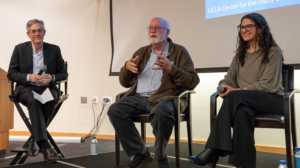
Fr. Boyle shares his refelections. Photo by Naheed Choudhry.
After all, he observed, Jesus called himself a doctor for the sick. He also empathized with those who found it difficult to live out Jesus’s exhortation to “love your neighbor as yourself”: after all, many people struggle with self-compassion. Alternatively, Fr. Boyle offered the suggestion to instead “love your neighbor as your child.”
Fr. Boyle translated this into action by extending loving concern to a gang member whom others told him to avoid, as he was “pure evil.” Later, this same gang member became recognized as a “Homeboy Hero.”
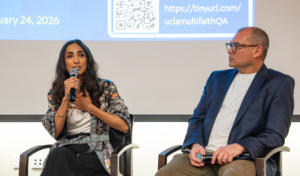
Valarie Kaur shares her philosophy of “seeing no stranger.” Photo by Naheed Choudhry.
Kaur built upon Fr. Boyle’s story by emphasizing that according to the Sikh tradition, there are no monsters in the world—only wounded people. It doesn’t make them less dangerous, Kaur says, but it makes us more free. She called empathizing with difficult individuals “heart work:” Kaur said, “The more you use it, the stronger it becomes.”
When Kaur faced a line of advancing ICE officers during a recent protest, she prayed: “Hot winds cannot touch you. You are shielded by the infinite…[They] could hurt me and beat me and take my life, but they could not end me. I [am] singing a song of love that began long before me.” The prayer reminded her that “revolutionary love is the choice to leave no one outside of our circle of care,” and motivated her to look at the ICE officers as “our brothers” and consider, “can we be brave enough to see no stranger? Can we be brave enough to tend the wound?”
Finally, the panelists shared a variety of stories, both from religious scripture and personal experience. Rabbi Brous shared a parable about a beloved sheep that opened King David’s eyes to the terrible consequences of his adultery and seizure of Bathsheba in order to illustrate the power of stories to awaken the moral imagination.
“God gave us capacious hearts to hold our pain and see others.” – Rabbi Brous
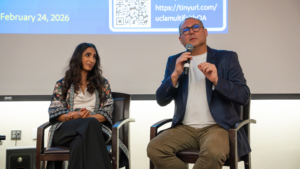
Imam Turk shares a personal story. Photo by Naheed Choudhry.
Imam Turk described the forgiving nature of God as well as a poignant reflection of a childhood visit to Hebron—where he saw fellow children being cruelly beaten. He then described his reluctance to take his children to visit Palestine to save them from a similarly traumatic experience. However, he was deeply impressed by his son’s maturity, who remained level-headed after encountering an angry pedestrian; after seeing his son’s compassionate response, Imam Turk traveled with him to Palestine.
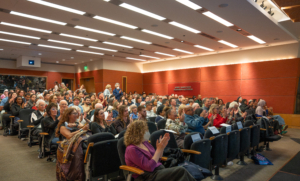
The audience applauds after Q&A with the panelists. Photo by Naheed Choudhry.
The panelists left the audience with transformative messages of hope. Imam Turk called the audience to be good neighbors—according to Islam, this includes knowing one’s neighbors “40 houses in every direction.” He also asserted, “Light is additive, not competitive.” Fr. Boyle urged each listener to embrace their own beauty: “If you know the truth of who you are, no one can touch you.”
Finally, Kaur invited the audience to consider America’s current state: “What if this is not the darkness of the tomb, but rather the darkness of the womb?”
Event Photos
By Naheed Choudhry
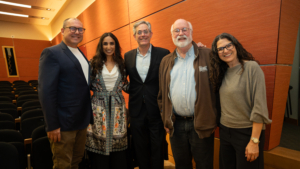
Imam Dr. Jihad Turk, Valerie Kaur, Prof. David Myers, Fr. Greg Boyle, and Rabbi Sharon Brous gather for a photo after the event.
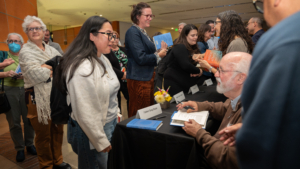
Fr. Boyle discuss with guests during the post-event b0ok signing.
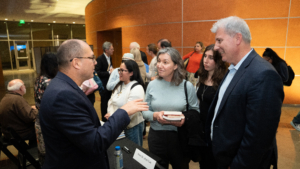
Imam Turk engages guests in conversation.
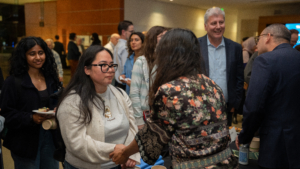
Valerie Kaur greets guests.
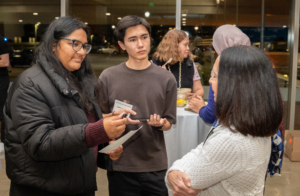
Dialogue across Difference interns Shreya Sundar and Aaden Poyuzina interview guests during the reception.
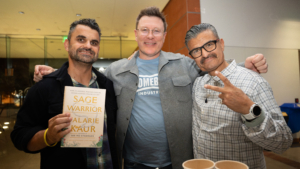
Guests pose for a photo with Kaur’s Sage Warrior during the reception.
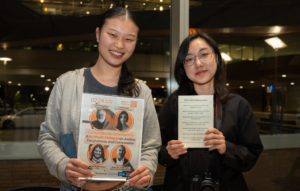
Dialouge across Difference interns Regina Lee and Hannah Park pose for a photograph during the reception.
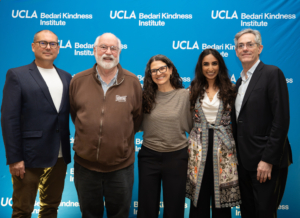
Faith leaders pose for a final photo together before departing.
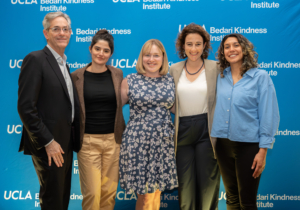
BKI Staff (L-R): Prof. David Myers, Amalia Mora, Megan Cox, Maia Ferdman and Felicia Graham.
About the Speakers
Father Greg Boyle is a Jesuit priest and director of Homeboy Industries, the world’s largest gang intervention and rehabilitation program.
Rabbi Sharon Brous is the senior and founding Rabbi of IKAR, a Jewish spiritual community in Los Angeles.
Valarie Kaur is a civil rights leader and activist, filmmaker, educator, best-selling author, and founder of the Revolutionary Love Project, a movement to reclaim love as a force for justice.
Imam Dr. Jihad Turk is the founding President of Bayan Islamic Graduate School, a preeminent Muslim institution of higher education.
