
Fall Convening Schedule
Location Public Affairs 4317 (anyone is welcome!)
Bruin Bridge Builder Fund
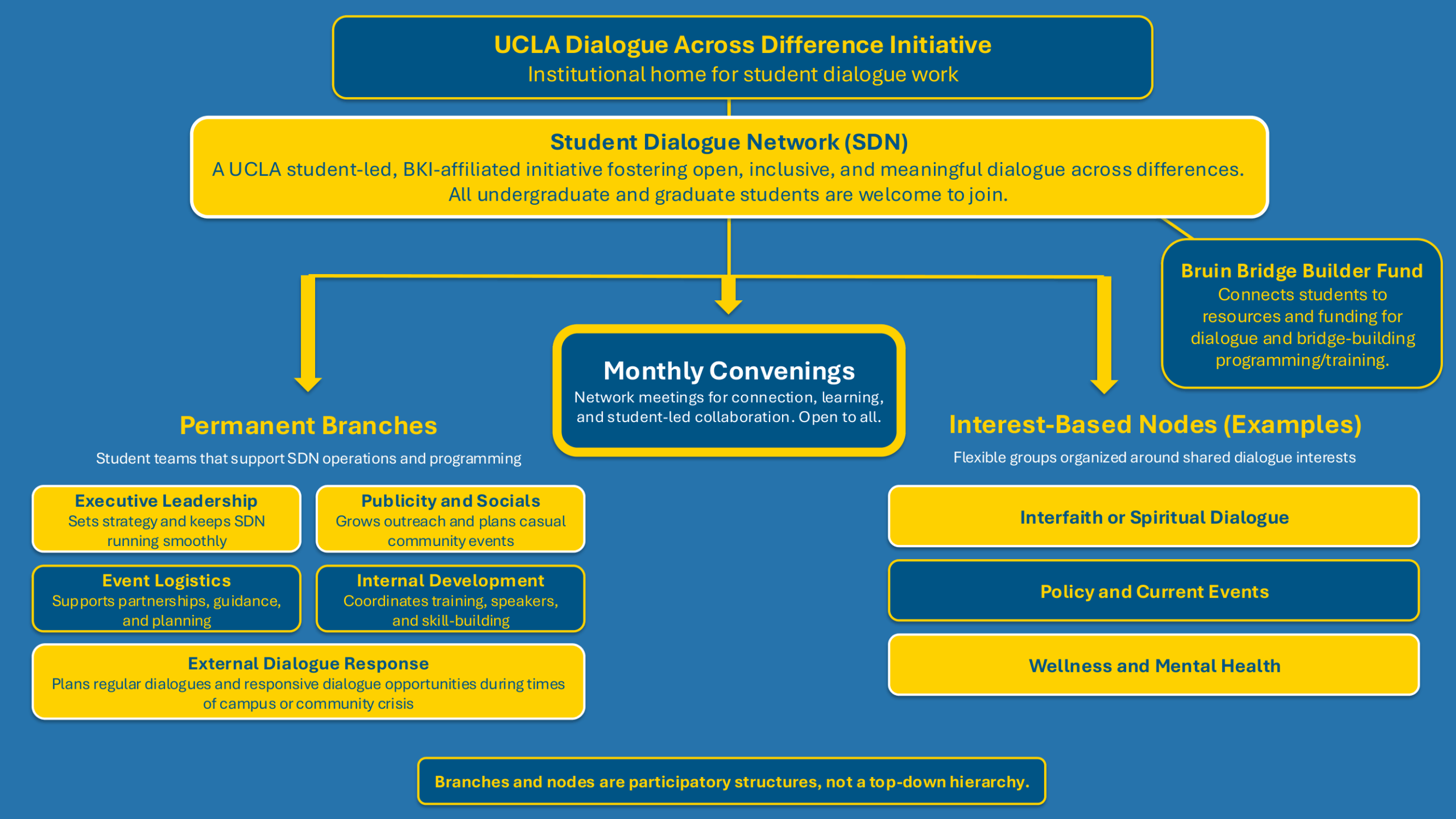
The Student Dialogue Network can connect you to resources and funding for dialogue/bridge-building related programming or training offered by the Bedari Kindness Institute. To learn more, either attend one of our meetings or click the button below.
Mission Statement
The Student Dialogue Network is a UCLA student-led, BKI-affiliated initiative dedicated to fostering open, inclusive, and meaningful dialogue across differences. In today’s age of extreme political polarization, we aim to create safe spaces for all Bruins, where individuals from diverse political affiliations, religions, and social identities can together explore sensitive topics, ask questions without judgment, and share lived experiences to build understanding and common ground. We believe that dialogue humanizes people, allowing us to see one another beyond labels, assumptions, and stereotypes. Rooted in curiosity, compassion, and courage, we equip students with the skills and confidence to engage in dialogue, embrace an open-minded attitude, and learn from one another. The SDN aims to help people cross divides of many kinds, including ideological, religious, cultural, political, and interpersonal differences. Through joint events, workshops, and community initiatives, we bridge divides, celebrate differences, and nurture a culture of respectful communication, growth, and compassionate thinking.
Organizational Guidelines/Ground Rules
- Please approach dialogue with respect, curiosity, and openness.
- Refrain from name-calling, labeling, profanity, or making large assumptions about others’ intentions.
- Attempt to recognize the difference that may exist between impact made and intention meant, whether it be in what you or others have said.
- Encourage clarification and active listening: listen to understand, not to respond.
- Actively provide space for all voices, particularly those often marginalized or overshadowed.
- Facilitate balanced participation, redirect conversations if someone dominates or interrupts.
- Encourage courageous dialogue while maintaining a safe and non-judgmental environment.
- Promote open inquiry and honest discussion, including difficult or controversial topics.
- Educate members on the difference between dialogue and debate.
- Support dialogue as a tool to humanize and understand, not to win arguments.
Membership Information
- All undergraduate and graduate students on campus are welcome to join.
- Failure to adhere to the ground rules will result in strikes issued by the network’s leadership team. Upon receiving each strike, the person will be encouraged to meet with leadership and take possible remediation steps. Upon receiving three strikes, membership may be terminated based on a vote taken by the entire organization.
Organizational Structure
SDN organization structure is subject to change as student needs/wants develop or shift.
- The SDN has different permanent branches, which include:
- Executive Leadership: This team works to set the strategic framework of the Student Dialogue Network in collaboration with all other branches and ensures that the organization is running smoothly.
- Current leaders: Aaden Poyuzina and Jack Elginer
- Currently looking for more people to join the executive committee
- Event Logistics: This team helps to facilitate collaborations between various organizations within the network, including but not limited to suggesting potential partnerships and then providing financial and logistical guidance as needed.
- Current leads: Not filled! Please reach out to us if you’d like to participate in this committee.
- Internal Development: This team will help to coordinate the professional development section of our monthly network meetings and lead the process of finding guest speakers and relevant training and professional development opportunities that can be held outside of meeting time and offered to all network members.
- Current leads: Not filled! Please reach out to us if you’d like to participate in this committee.
- External Dialogue Response: This team will be responsible for planning and hosting regular dialogues that students can come to, with a particular emphasis on this happening during times of crisis where dialogue can serve to be valuable as a responsive tool. Some level of experience facilitating is preferred.
- Current leads: Not filled! Please reach out to us if you’d like to participate in this committee.
- Executive Leadership: This team works to set the strategic framework of the Student Dialogue Network in collaboration with all other branches and ensures that the organization is running smoothly.
- The SDN also includes several interest-based nodes led by individuals passionate about specific topics, such as intercultural and identity dialogue, policy and current events, wellness and mental health, and interfaith or spiritual dialogue. These nodes may choose to meet during network meetings or, depending on their level of activity, schedule separate times to connect, deepen discussions, and develop programming over a longer-term timeline. If you’re interested in facilitating a specific node, reach out to the executive team!
- Current nodes:
- There is no formal application to join or take on a leadership role within the network. This organizational structure is designed to be participatory, giving everyone the opportunity to take an active role in the network. There are no requirements to participate on a branch team.

Dialogue Across Difference Initiative
1500 Public Affairs Building
337 Charles E Young Dr E
Los Angeles, CA 90095